Escalation Culture
Why small problems keep travelling upwards
2 min read
A bin went uncollected for three weeks before anyone made the one phone call that would have fixed it. What the delay reveals about authority, initiative, and the culture managers build without meaning to.
Some management lessons arrive in strategy papers. Others arrive disguised as an overflowing rubbish bin.
A practical reflection on decision-making, accountability and the invisible boundaries that can prevent staff from taking ownership.
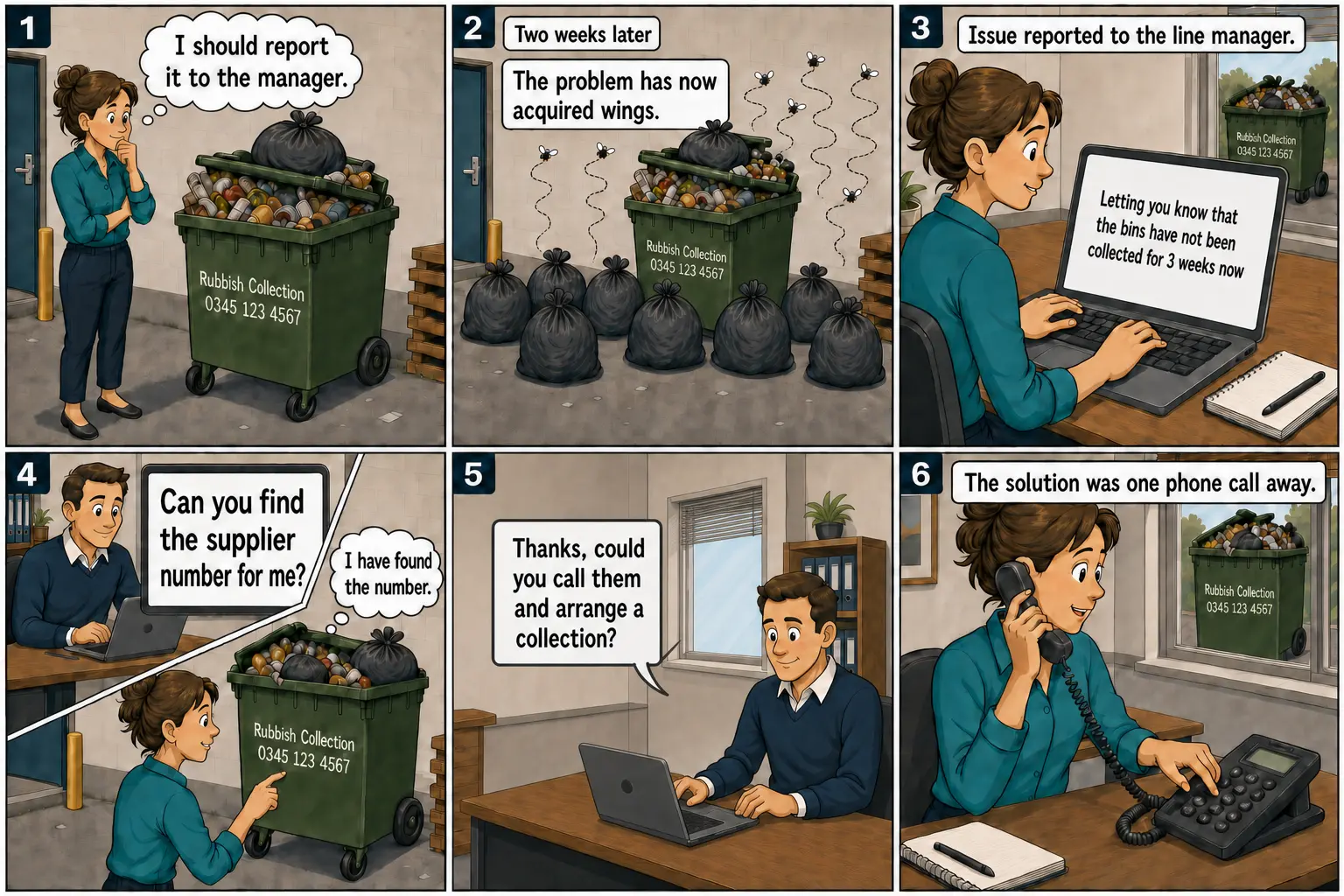
Three weeks. That is how long a bin sat outside quietly becoming a biohazard before anyone picked up a phone. A manager, when finally told, set a small test: could the staff member locate the collection company's phone number? She could, in minutes, straight off the side of the bin. The second test followed right behind the first: now that she had it, would she use it? Only once she was told to.
The solution was one phone call away.
It would be easy to interpret this simply as a lack of initiative. But a more useful management question is: why did someone feel able to find the number, yet not feel able to use it?
Did they believe they were allowed to act?
Authority is communicated through more than policies and job descriptions. Staff also learn from experience: what happens when they make a decision, whether reasonable mistakes are supported, and how often managers step in and take over.
An escalation culture can develop unintentionally.
- Managers want to be helpful, so they respond quickly and solve the problem.
- Staff learn that referring matters upwards is safer than making a judgement.
Eventually, "tell the manager" becomes the automatic first step - even when the issue is routine and the solution is within reach.
Before asking why someone failed to act, ask whether they genuinely believed they were allowed to.
That does not remove individual responsibility. Empowerment works only when people are willing to use the authority they have been given. However, managers must make that authority visible, practical and safe to exercise.
When should staff act, inform or escalate?
Not every escalation is unnecessary. Matters involving safety, significant expenditure, legal obligations, safeguarding or serious reputational risk should reach the appropriate manager promptly.
The difficulty arises when low-risk, reversible problems follow the same route. Delay can turn a minor operational issue into a larger one while managers become bottlenecks for decisions others could reasonably make.
A simple decision check can help:
- Is the issue low risk?
- Is the proposed action reasonable and reversible?
- Do I have the information and tools required?
- Could waiting make the situation worse?
- Does the decision fall within my agreed responsibilities?
If the answers point towards safe action, the employee should take the first reasonable step and update the manager where appropriate. If the consequences are significant or the boundaries genuinely unclear, escalation is the right response.
The working principle is simple:
Act on low-risk issues, inform when appropriate, and escalate when the consequences genuinely require it.
For managers, this means defining decision-making boundaries and supporting reasonable judgement. For staff, it means bringing ownership alongside the problem: not only "This has happened," but also "Here is the first step I can take."
The overflowing bin was not really the management issue. The issue was the invisible boundary between noticing a problem and feeling authorised to solve it.
How clear is that boundary in your team?